The 50-Page Rule for Audiobooks and E-Books

The 50-page rule was built for paper. In that world a page is both something you can count and a marker of progress. Today, however, a large share of reading happens on screens and in earphones — and in both, the "page" either does not exist or is a synthetic number. The result is that many readers never apply the rule to audiobooks, not because they disagree with it, but because they have no idea at which minute they are supposed to decide.
This article does one thing: it takes the rule out of the unit "page" and translates it into two usable units — minutes for audio, percent for screens. For the underlying logic and the origin of the rule, see the main article on the 50-page rule, and for Nancy Pearl herself, the complete file on Nancy Pearl.
Why "page" is a bad unit
Even in a printed book a page is a variable unit. One page of a paperback in small type can hold four hundred words; the same text in a large-format edition with generous type might hold two hundred. Translators change length as well: a Persian translation of an English novel is typically longer than the original. So when we say "fifty pages," we do not actually know how many words we have agreed to.
In an e-book the story gets worse. Many digital files have no page numbers at all and show only a percentage of progress. In other formats, page numbers are generated from a fixed map that is independent of your font size and settings — so "page 50" is a stable number, even if what appears on your screen is something else entirely.
In an audiobook, pages are simply zero. No listener can say "I heard page forty."
| Format | Real unit of progress | Practical note |
|---|---|---|
| Printed book | Page number | Varies with trim size and typeface; treat it as approximate |
| E-book with a page map | Page number | Stable, independent of your display settings |
| E-book without page numbers | Percent of the book | Percentage is the only stable unit |
| Audiobook | Minutes (at 1x speed) | Playback speed moves wall-clock minutes, not content |
Audiobooks: from pages to minutes
There is a clear rule-of-thumb calculation. A professional narrator reads at roughly one and a half times the pace of ordinary conversation; and a standard printed page holds around two hundred and fifty words. With those two figures, each printed page becomes about one and a half to two minutes of recorded audio.
Fifty pages, then, is roughly eighty to a hundred minutes of audiobook. But a practical constraint enters here: time in audio is not the same as time on paper. Reading print is an active act and you control the pace; listening can happen in the margins of other tasks.
That is why practical lists give a shorter audiobook threshold — about forty-five to sixty minutes. That number is not an exact conversion of fifty pages; it is a workable floor. Keep the distinction in mind: the arithmetic conversion gives about ninety minutes, the practical threshold about one hour.
There is also a technical trap that gets little attention: playback speed. If you listen at 1.5x, sixty minutes of your clock equals forty minutes of content. To keep the rule consistent across settings, always calculate the threshold at 1x, or divide your wall-clock figure by the speed multiplier.
E-books: from pages to percent
In a digital book the simplest approach is to think in percent. Scaling the 50-page rule proportionally — fifty pages of a roughly three-hundred-page book is close to a sixth of it — the general threshold lands at about 10 to 15 percent.
The good news about digital books is that they show percentage progress everywhere, which makes the 50-page decision easier than on paper. The bad news is the same thing: unlike paper, you cannot see how many more evenings this book is going to cost you.
Paper gives you physical feedback. Holding the book, you feel the remaining thickness: the pages still on the right say "a long way to go," and that feeling shapes your decision without you noticing. On a screen, that feedback is zero. Experience suggests that screen readers take longer than paper readers to tire of a dull book — because what used to convert tiredness into a decision was a physical sensation.
The practical remedy: give your threshold a date rather than a number. "If this book is in the same place by next Friday, I put it down." A date replaces the physical sensation.
Two factors that exist only in audio
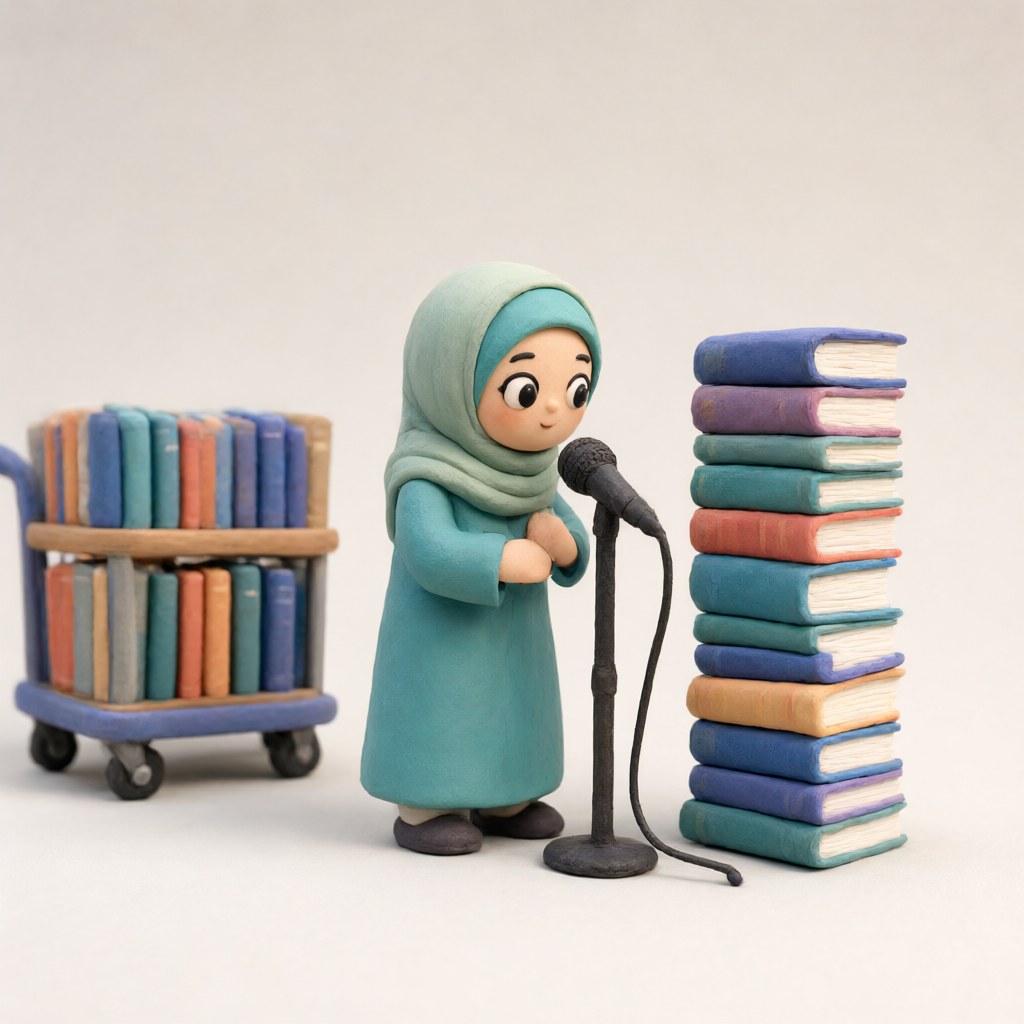
In an audiobook a variable enters the game that has no counterpart on paper: the narrator. A mediocre book with a brilliant performance can carry you; a brilliant book with a lifeless one becomes unpleasant. So with an audiobook you are judging two things at once: the text and the performance.
The remedy is right there: the free sample. Most audiobook services offer the opening minutes at no cost. That sample is exactly what the 50-page rule provided on paper — a short, cheap window in which to decide.
- Listen to the sample before you buy the audiobook, and decide on that.
- If the narrator does not work, change format, not book — the same text on paper may work perfectly.
- Trust your mood more in audio than in print — listening is involuntary, and distraction is one of the most honest signals you have.
Conversion table: the rule of 50 in four formats
| Format | Conversion basis | Decision threshold |
|---|---|---|
| Printed book | Fifty pages | 50 pages, or a tenth to a sixth of the book |
| E-book | Percentage | 10 to 15 percent |
| Audiobook (exact conversion) | Minutes at 1x | 80 to 100 minutes |
| Audiobook (practical threshold) | Minutes at 1x | 45 to 60 minutes |
The "at 1x" in the last two rows is deliberate. If you listen faster or slower, your wall-clock time is not the measure; the amount of content you have heard is.
Conclusion: keep the rule, change the unit
The 50-page rule is not really about "fifty." It is about a fixed point at which you decide. Its unit — the page — was tied to the paper format, which is why it fell apart in newer formats. Translated into minutes and percent, the same rule becomes usable again: about an hour for an audiobook, about ten to fifteen percent for a digital book, and the original fifty pages on paper.
And like any rule, this one has exceptions — books not written to be read linearly, and books read outside your own desire. We gather those in where the 50-page rule breaks down.