Print vs Digital Photo Albums: Lasting Value, Cost, and Feel

Why Has Choosing Between a Printed and Digital Album Become So Hard?
Half a century ago, the answer was clear: a photo landed on paper, the paper went into an album with thick pages, and there it stayed. Today, that same photo is scattered across a phone, the cloud, two unnamed folders on a laptop, and family messaging groups. It is this dispersal that makes the choice difficult; we are no longer choosing only between “paper” and “screen,” but among several models of care.
To move the decision beyond personal taste, we examine three criteria separately: longevity, cost, and the quality of the viewing experience.
Longevity: The Real Lifespan of Paper and Files
Archival paper, unlike cheap writing paper, is made without lignin; that is the substance that causes yellowing and brittleness in old sheets. Standards such as ISO 9706 estimate the lifespan of such paper, under proper storage conditions, at several hundred years. More important, however, is the ink: printing with pigment ink on acid-free paper is, in tests by Wilhelm Imaging Research (Henry Wilhelm), dozens of times more stable than cheap color printing on ordinary paper. The printed photos of the 1980s that were left in sunlight behind glass and lost their color were precisely victims of those cheap inks.
Why Is No File Everlasting by Itself?
The common assumption is that a digital file does not decay, but a file also has a physical substrate. Mechanical disks have an average useful life of three to five years, flash memory loses its electrical charge when not connected to power, and cloud services also have a limited commercial lifespan. In 1992, Kodak introduced Photo CD as the future of photo preservation; less than two decades later, the computers that could read that format had become obsolete. Cloud service shutdowns have no shortage of bitter examples: users who entrusted years of archives to a single account lost their files when policies changed or the service ended.
The technical conclusion is clear: Good paper, absent disaster, outlives a good file; but a file is the only version that can be duplicated endlessly. These two complementary characteristics are the foundation of the hybrid solution that follows.
Cost: Let’s Put the Numbers on Paper
At first glance, the cost of a digital album seems to be zero, but that picture is incomplete; most of the cost remains hidden. The table below offers a more realistic comparison:
| Criterion | Printed Album | Digital Album |
|---|---|---|
| Upfront cost | One-time and predictable | Close to zero |
| Recurring cost | Almost none | Cloud subscription, disk replacement, format migration |
| Longevity | Decades to centuries | Dependent on hardware and company |
| Search and sharing | Difficult and slow | Instant and broad |
| Vulnerability | Water, fire, insects | Disk failure, accidental deletion, hacking |
If you keep at least two copies of a digital album and migrate it to a new format and medium every few years, its ten-year cost can surpass that of a high-quality printed album. On the other hand, careless printing is also expensive: printing two hundred duplicate frames from a party raises the album’s cost and lowers its value for viewing.
The Feel of Turning Pages: What a Screen Cannot Give Back
Viewing a printed album is slower, more scattered, and therefore deeper. Page-turning creates a natural pause; the very pause that gives memory a chance. By contrast, swiping a finger across a screen habituates us to speed, and the mind passes over photos like an endless stream. Susan Sontag writes in On Photography that photographs are reminders of death; a photo set in a paper frame and passed from hand to hand makes that reminder more tangible.
A printed album is an object; a digital album is an access point. The former takes its place on a shelf and opens on the table at a family gathering; the latter exists only when someone goes looking for it.
This difference also shows up in everyday use: grandparents usually struggle with tablets, but they turn the pages of an album with confidence.
Third Way: Two-Layer Archive
You don’t have to sacrifice one of the two options. The proposed model follows the same “3-2-1” principle in data preservation, which can easily be combined with family needs:
- Print layer: Print one curated album each year using acid-free paper and pigment ink; not all the photos, but the best ones.
- Digital layer: Keep all files in three copies; two copies on different physical media and one copy outside the home.
- Scanning old photos: Scan worn paper photos at least 600 dots per inch for print and 1,200 dots per inch for negatives, and save them in uncompressed TIFF format.
- Labeling: Record people’s names, dates, and locations immediately; an unlabeled photo loses its value after two generations.
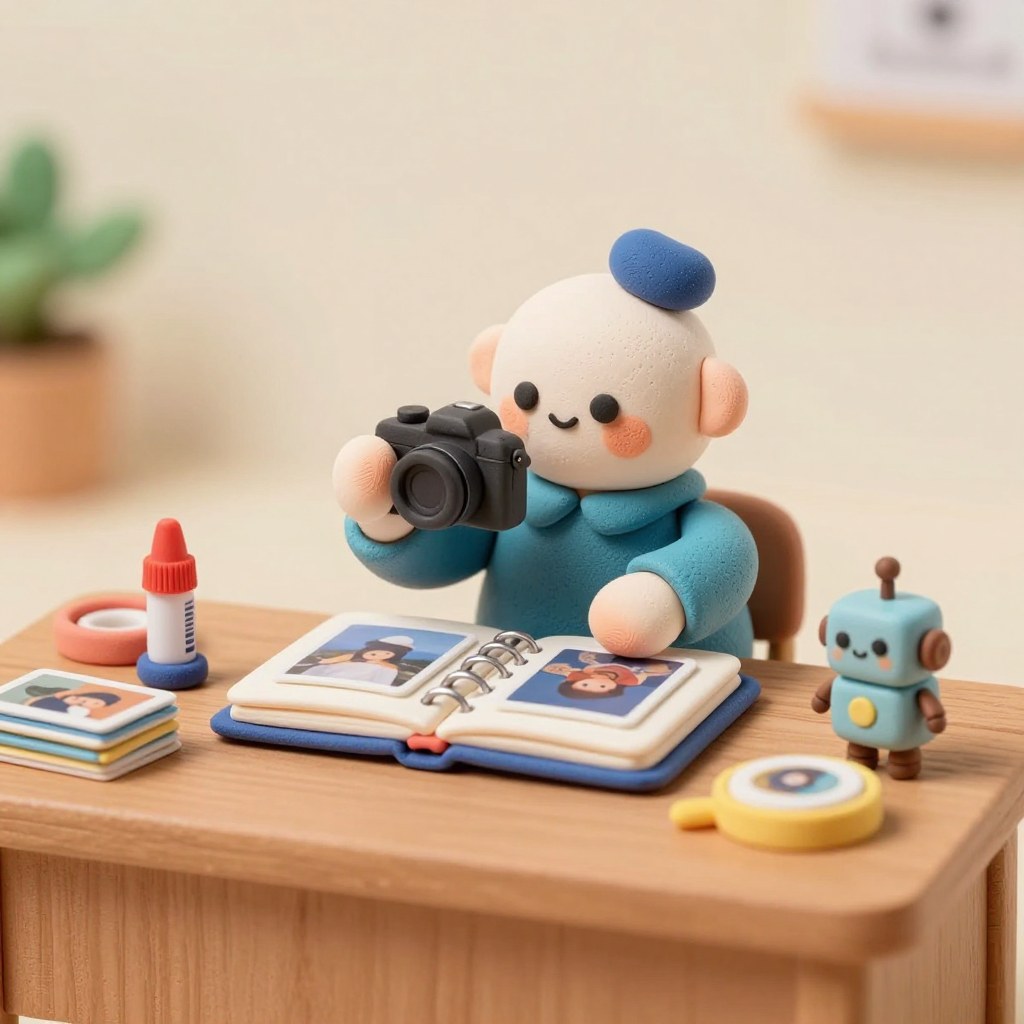
- Periodic review: Every two years, migrate the files to healthier media and photograph the albums so you have a backup copy.
Conclusion
If the criterion is long-term durability, the printed album with archival materials wins. If the criterion is accessibility, searchability, and quick sharing, digital is unrivaled. But neither is complete on its own: print without a digital copy is fragile, and a digital archive without print loses the shared family experience. The right decision is to ask for whom and for how long you want to keep these memories; the answer to that very question determines the balance between print and digital files.