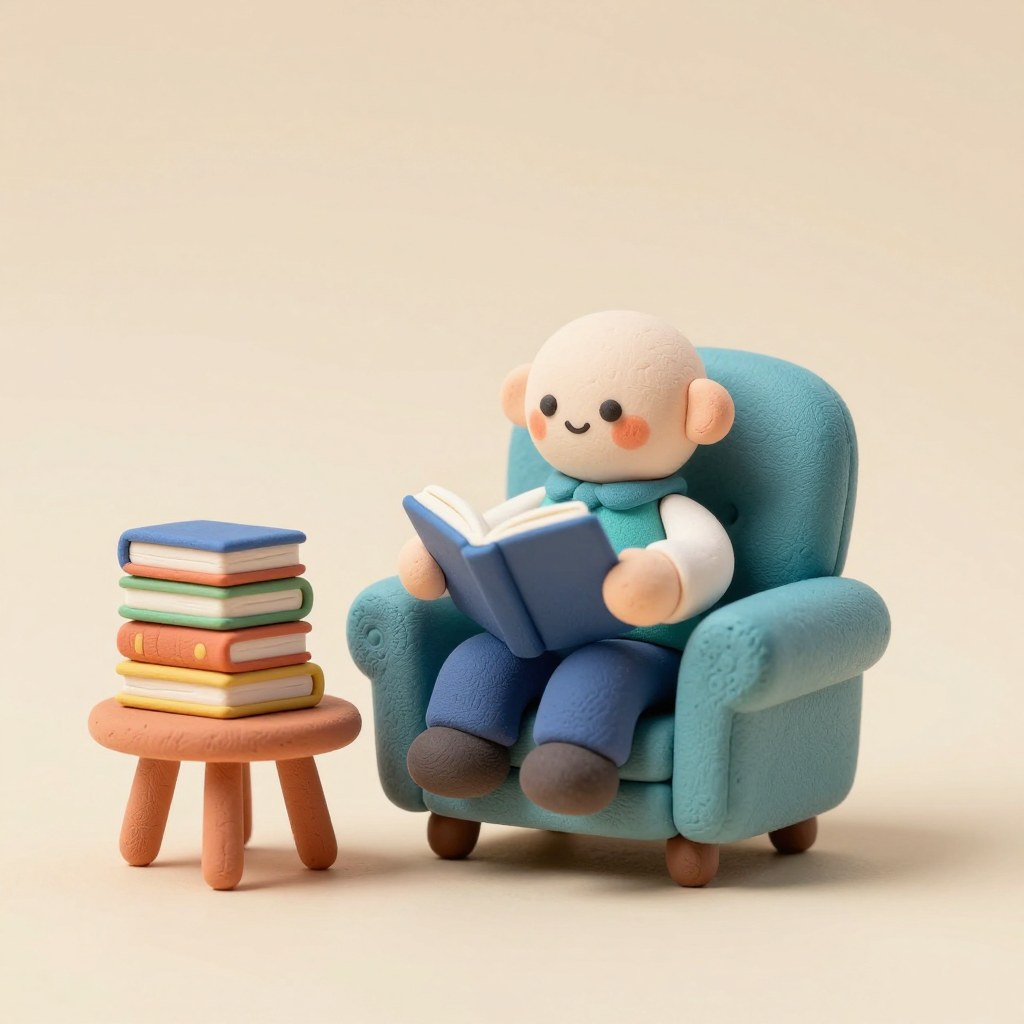
Unread Books: Tsundoku and the Antilibrary

Almost every serious reader has a corner of the house they would rather not discuss: a shelf of books bought with the intention of reading and never read. That shelf is an endless source of guilt — and it also has an exact name, given to it by Japanese speakers centuries ago, and a philosophical argument that turns it from guilt into capital.
This article has three layers: the origin of the word tsundoku, the argument of the antilibrary, and the reading statistics that actually hold up — as opposed to the ones the internet invents. At the end, a simple method for sorting the pile. If the idea of abandoning a book is new to you, start with the 50-page rule.
Tsundoku: a name Japanese speakers found centuries ago
Tsundoku is built from two elements: one meaning "to pile up," the other pointing to "reading." The result is a concept with no single-word equivalent in English: buying and accumulating books that, in practice, never get read.
The important historical point is that tsundoku is not a new coinage. Its roots reach back to the Meiji era — a period when Japan was racing towards mass literacy and industrial printing, and the book became, for the first time, a commodity bought in greater quantity than its buyer could read. Tsundoku is therefore a product of a thoroughly modern condition: the speed of buying separating from the speed of reading.
The word entered English over the past decade, beginning around the mid-2010s and reaching the cultural vocabulary after press coverage in 2014 and 2018. Its success is easy to explain: it names precisely what millions of people were experiencing and had no word for.
The antilibrary: from Eco to The Black Swan
The second layer is more intellectual. The term "antilibrary" was coined by Umberto Eco, the Italian writer and semiotician. In his writing — including a discussion of Jonathan Swift's Gulliver's Travels — Eco insisted that unread books are no less valuable than read ones. The idea reached its famous form through Nassim Nicholas Taleb's The Black Swan (2007):
Read books are far less valuable than unread ones. The library should contain as much of what you do not know as your financial means allow you to put there. You will accumulate more knowledge and more books as you grow older, and the growing number of unread books on the shelves will look at you menacingly. Indeed, the more you know, the larger the rows of unread books. Let us call this collection of unread books an antilibrary.
In that same text Taleb describes Eco's personal library as containing thirty thousand books. One caveat is needed: that figure is Taleb's description of Eco's library, not an official catalogue count. If you see the number presented as precise data, do not press it — it works as a story, not as a statistic.
The argument itself, however, stands independently of the number. In the logic of the antilibrary, an unread book does three things: it shows you the boundary of what you know; at the moment of need it either answers your question or does not; and it keeps reminding you that the world is larger than what you have read. None of those three things happens with a book you have finished.
Reading data: what holds up and what does not
Before any practical advice, know this: almost every figure circulating about "how much we read" has no source behind it. The precise numbers about "minutes per day" or "average minutes of reading per year" that get shared so confidently usually have neither a source nor a transparent sampling method. Do not cite them.
What does hold up is data from serious research institutions — and among those, the Pew Research Center's surveys in the United States are among the most widely used. Its most recent survey, based on a sample of roughly eight thousand American adults, paints the following picture (the figures are US-only):
| Finding | Share | Note |
|---|---|---|
| Read all or part of a book in the past year | 75% | Meaning a quarter (25%) read no book at all |
| Read 1 to 5 books a year | 38% | The largest group |
| Read 6 to 10 books | 13% | |
| Read 11 to 20 books | 10% | |
| Read more than 20 books | 14% | The group that shapes the public image of "a reader" |
Comparing this with a Pew survey from years earlier is instructive too: the mean reported then was about twelve books a year, but the median was only four. The mean was dragged upward by a small group of heavy readers — the same 14% at the top. For most people, the reality is closer to four or five books a year, not twelve.
And to be blunt: no trustworthy figure for average reading in Iran or the UK could be verified. If you meet a number specifically about one of those countries, ask first which institution measured it and on what sample; the answer is almost always empty.
Three things that get confused with each other
It helps to separate these three, because each has a different remedy:
- Tsundoku — legitimate accumulation. Buying more than you can read, with no pretence involved. It comes mostly from optimism, not laziness.
- The antilibrary — a deliberate resource. A mass of unread books explicitly accepted as tools and capital. It differs from tsundoku in that you do not defend the current not-reading; you treat it as temporary and purposeful.
- Aimless hoarding — a third thing. Buying as a substitute for reading, to fill shelves or quiet anxiety. This is the only genuinely troubled state on the list, and its signature is that none of those books appear anywhere in your actual future plans.
The practical distinction is simple: if you can say under what circumstances you will reach for most of your unread books, you are in the first two groups. If the answer is "never, but I can't throw them out," you are in the third.
Turning the pile back into an asset
- Count them once, then accept the number. Know the real figure. Most people assume it is larger than it is; knowing it kills both the legend and the anxiety.
- Two questions, three piles. Ask each book two things: "will I reach for this in the next realistic twelve months?" and "is this the reference I would consult for a question?" The answers produce three piles: this year, reference, and out.
- Catalogue the library by question, not by title. This is the essence of the antilibrary idea. For each unread book, note down "which question does this book answer?" A list built on questions is usable at the moment of need; a list built on titles is merely decorative.
- Act on the "out" pile. Donating or selling them returns your shelf to a truthful state and, more importantly, closes the decision. A book left in limbo for years does more damage to a reading habit than its absence would.
There is one more useful signal: if most of your unread books sit in a single area — all psychology, or all history — that accumulation is not random. It is the sign of an unread queue for a mental project. Treat it as more serious than guilt and check whether you are in fact pursuing that project.
And if the books you keep abandoning are the ones taking your reading habit away, that problem is treated separately in reading slumps and how to recover. To record and review your abandonments, see DNF culture and the four-column log.
Conclusion: today's unread book is tomorrow's asset
The pile of unread books comes from two places: optimistic buying and limited time. Neither is a failure. Tsundoku is the name for the optimism, and the antilibrary is a way to convert it from guilt into capital — provided you count your own numbers once and organise the shelf by question rather than title. For the wider framework behind these decisions, go back to the main article on the 50-page rule.