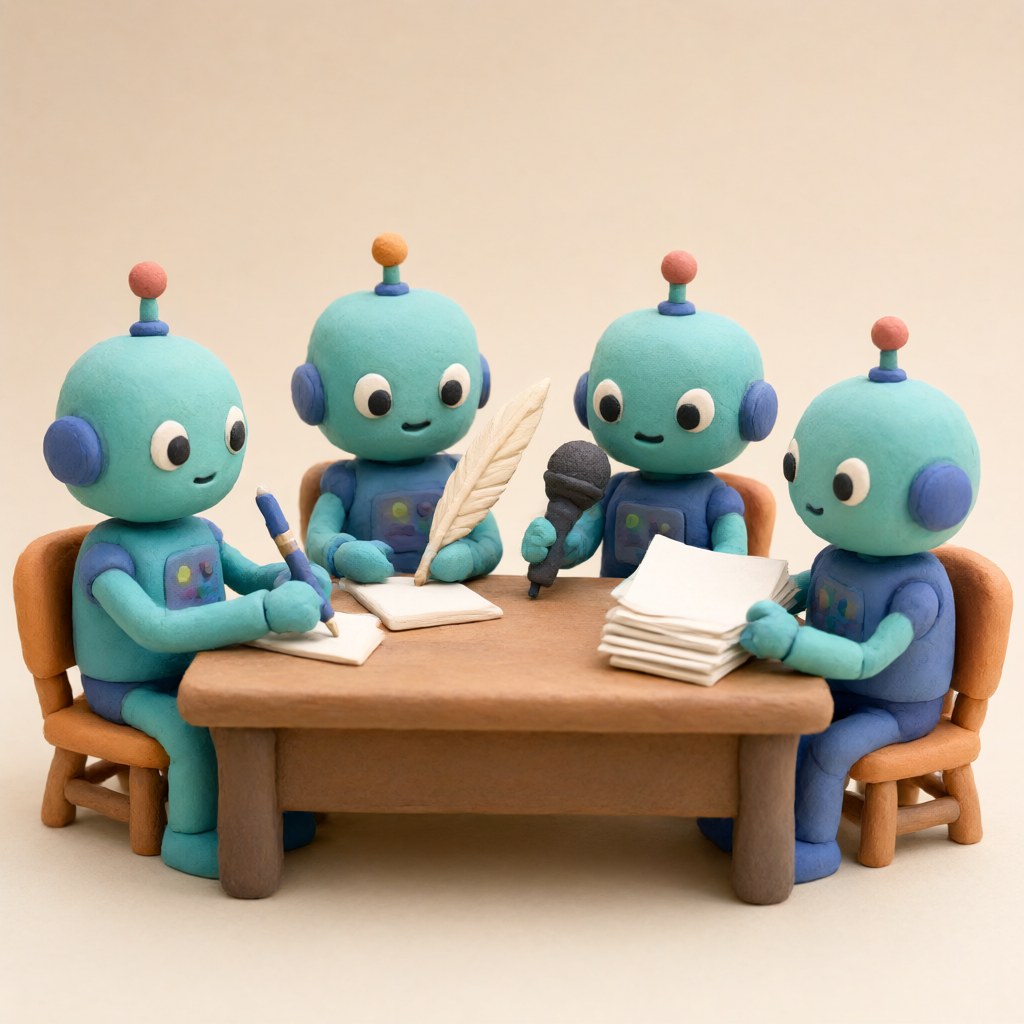
Writing with AI: From Idea to a Published Book (and What Nevispar Does)

The right question is not "can AI write a book?" — experience shows it can produce a draft. The right question is: which part of the work do we hand to the machine, and which do we keep? This guide walks the path from idea to a published book and shows what Nevispar takes off your hands at each step.
Step 1: Choose the document type
Before anything else, know what you are writing. A novel and a thesis want two different voices. The document type sets the tone, the structure, and even chapter length. Nevispar covers this starting point with several specialised document types: from a novel, short story, science fiction and fantasy to a thesis, a scientific paper, a textbook, business, technical, poetry and screenplays.
Step 2: The book outline and brief
This is the most sensitive step. "A book about…" is not a brief; a real brief says who the audience is, what the tone is, how deep to go, and what each chapter must achieve. In Nevispar the outline and brief are built before generation and shown to you in an editable review form: title, guiding questions, characters, foundational facts (setting, time, identity), open story loops, summary and tone. Right there, where you should correct things — before a single word is generated.
Step 3: Section-by-section generation
Generating everything in one long burst lowers quality and loses control. The better path is to break each chapter into smaller sections; each section is generated and reviewed independently. This reduces repetition, allows pausing and resuming, and lets you catch conflicts early. In Nevispar you set the number of independent sections per chapter and, if your plan allows, choose the AI provider.
Step 4: Human editing — where the work becomes yours
- Rewrite the first and last page of each chapter yourself; that is your signature.
- Read dialogue aloud and make the spoken tone human.
- Fact-check statistics, names, dates and references independently.
- Cut padding and repetition; simplify anything unclear.
The Nevispar editor makes this easy: paragraphs, headings, lists, quotes, dialogue, tables, images, charts, timelines and footnotes, with a live page preview in A5/A4. In other words, you edit inside the environment where you see the finished book.
Step 5: Output and typesetting
A professional book needs professional output. At the end of the path, the text must convert cleanly into standard formats. Nevispar exports to several formats — PDF (A4/A5), Word, PowerPoint, EPUB, HTML, Markdown and JSON — with right-to-left layout, an automatic table of contents, a cover and an ISBN.
Ethical limits and authenticity
- Labelling: follow publishing platforms' rules for AI-generated content.
- Fact-checking: never publish a number or source without confirming it.
- The work's voice: human editing is the line between "your book" and "a machine's output".
What Nevispar does for you
- Builds the book outline and brief, with guiding questions and a review form before generation.
- Generates chapter by chapter and section by section, keeping story memory from chapter one.
- Provides a visual editor and a live A5/A4 preview for precise typesetting.
- Exports to PDF, Word, PowerPoint, EPUB, HTML, Markdown and JSON with automatic contents and cover.
- Resumes generation after you close the page, with no chapters lost.
AI gives speed; you build the voice. A book is the product of a well-drawn division of labour between the two.