Audiobook, Ebook, or Print? A Guide to Choosing Your Book Format

To be honest, every book is a decision before it is read: should it appear on paper, open as a file, or be heard as audio? This question has two different answers for an author who has just finalized the manuscript and for a reader with limited time. Changing format is not merely changing the container; it shifts the pace of the narrative, the level of concentration, and the audience market. In this article, we examine three paths separately, lay their costs and advantages on the table, and at the end offer criteria for choosing.
Print Books: A Medium That Limits Distraction
Paper has an unassuming but serious advantage: it removes competition from the page. In a printed book there are no notifications, no external links, and no other tab waiting. Research in reading psychology has shown that readers of paper text better remember where on the page or on which side of the book a point appeared; these spatial cues help memory retrieval. For textbooks, legal texts, and poetry, this feature carries considerable weight. For someone leafing through Hafez’s Divan, part of the experience is finding the same ghazal again on the same page.
From the author’s perspective, print is the most expensive route. Print runs, warehousing, return costs, and distribution require upfront capital, and market feedback reaches you slowly. In exchange, the printed book is still a benchmark of credibility in many situations, from introductions at events to gift-giving.
E-books: Text That Can Be Searched
The standard EPUB file reflows text to fit page size and font size (reflowable), whereas PDF preserves a fixed page. For a novel, EPUB is the natural choice; for a book with complex tables, formulas, and layout, PDF is less error-prone. Platforms such as Taaghche and Fidibo in Iran and Kindle and Google Play Books in the global market have shortened the publishing path: one file, no print run, with the ability to update the edition and release subsequent revisions without warehousing paper.
The main advantage for the reader is search. When you are reading a six-hundred-page book on biostatistics, finding a definition or a table in seconds is the difference between reading and abandoning the book. Highlighting, note-taking, and syncing across devices also make things easier. On the other hand, battery dependence, digital locks (DRM), and eye strain during long reading sessions are real limitations that cannot be ignored.
Audiobooks: When Ears Do the Work
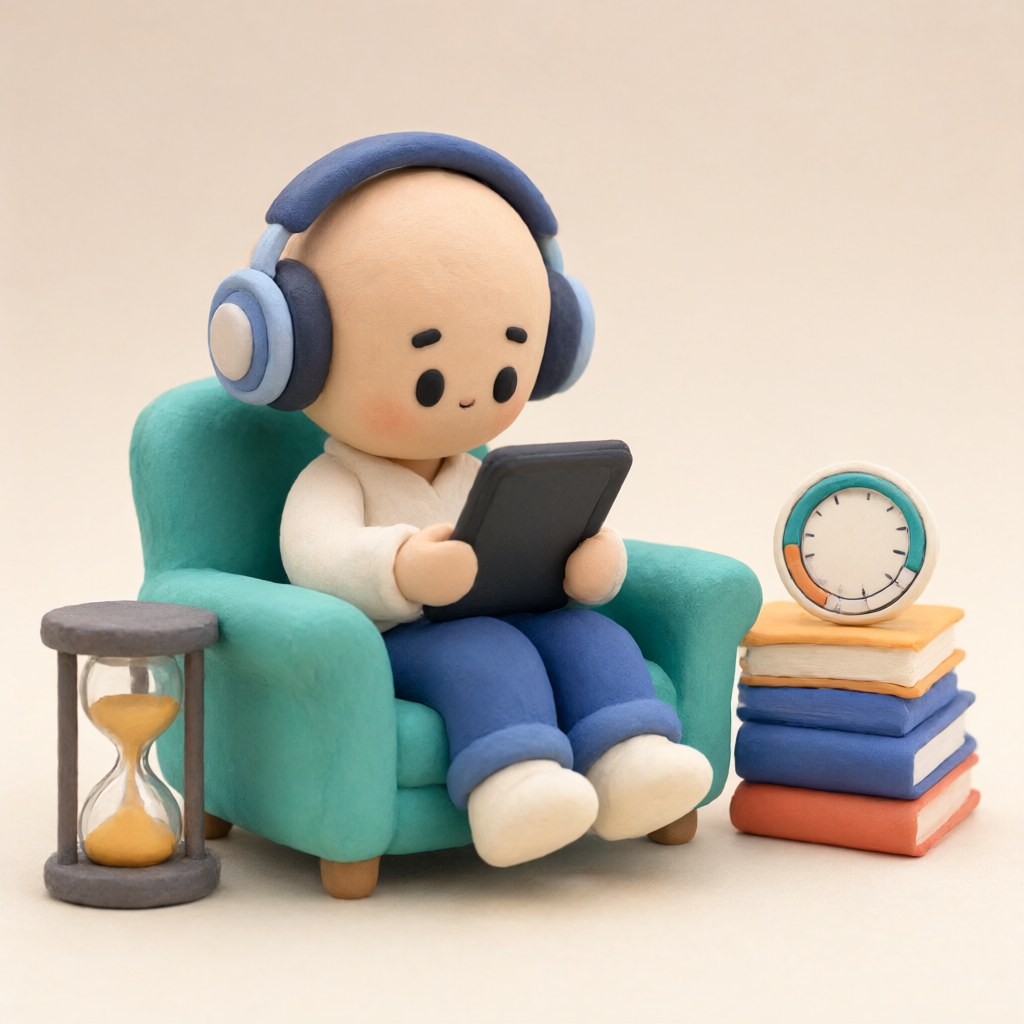
Audio is a path for times when hands and eyes are occupied: commuting, walking, household chores. This very feature creates a new audience: people who might not read even one paper book a year, but listen to two audiobooks a month. The ability to increase playback speed to 1.5x or more has also made this format appealing for nonfiction. On Kindle, text-audio synchronization (Whispersync for Voice) lets you make progress by listening at night and continue in text from the same point in the morning.
However, audio cannot accommodate every book. Novels, essays, and biographies fit well in this format because they have a linear narrative. A book full of exercises, tables, footnotes, and visual references gets lost in audio; the listener cannot, like a reader, go back and look at a formula again. Narration quality is also decisive: synthetic voice has improved day by day for news and instructional text, but in literary and humorous writing it still does not match a human narrator. Mispronouncing names and technical terms lowers the book’s credibility.
Quick Comparison of the Three Formats
| Criterion | Electronic | Audio | |
|---|---|---|---|
| Upfront investment | High | Low | Moderate (studio and narrator) |
| Time to publication | A few weeks to a few months | A few days | A few weeks |
| Reading experience | High concentration, spatial cues | Easy search and note-taking | Suitable for multitasking |
| Going back and browsing | Medium | High | Low |
| Suitable for | Poetry, gifts, textbooks | Reference books, nonfiction, novels | Novels, essays, biographies |
| Accessibility | Requires carrying the book | Text magnification and search | Suitable for the visually impaired and blind |
How Do You Choose Your Own Path?
- Where does your audience spend their time? If your main audience is students and professionals, the electronic file reaches them faster; if you wrote it as a gift, print takes precedence.
- Is the book linear or a reference work? Any text the reader has to jump around in and search through performs poorly in audio.
- What are your budget and timeline? Printing requires capital, audio requires a studio and narrator, and releasing a file costs almost nothing.
- Does the book contain images, tables, or formulas? These elements are displaced in EPUB and lose their usefulness in audio; PDF is more faithful.
- Do you want to combine the versions? One text can yield three products at once; the electronic version can be published several months before print so that feedback arrives sooner.
“The right format is not the most appealing format; it is the format that delivers the book to the audience at the very time they can actually read or listen to it.”
Conclusion
The three formats are not three competitors; they are three entry doors into one text. If your book is narrative-driven, audio and paper have the greatest impact. If it is a reference or instructional work, the electronic file offers more room to maneuver. In today’s market, the professional choice is usually not “either/or” but “in sequence”: first the electronic version for speed and feedback, then print for credibility and gifts, and finally audio for audiences who do not have time to read. The one point not to lose sight of is that each format needs its own editing; a file created for print does not become an audiobook without revision.