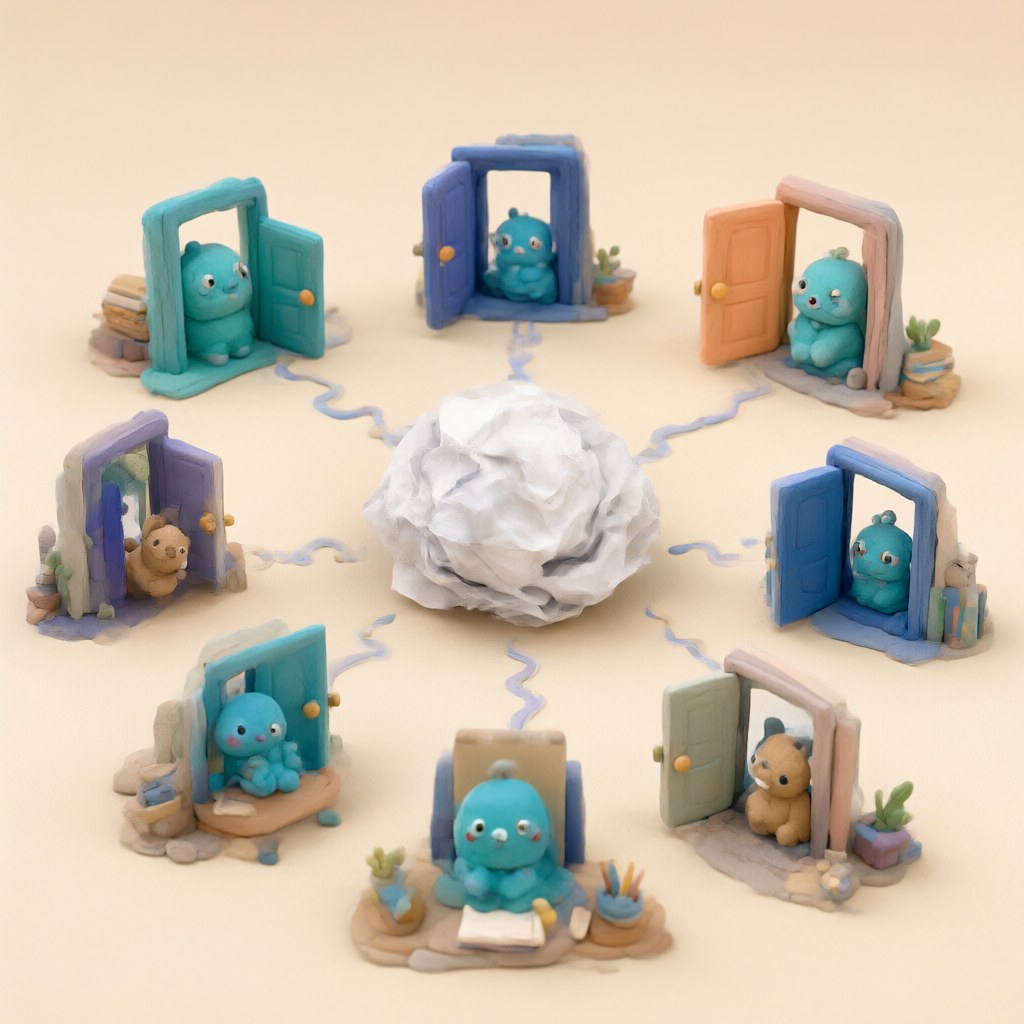
Brainstorming That Actually Yields Ideas: A Written Version for Writers and Content Teams

The weekly content meeting starts and repeats what happened last week: the manager asks whether anyone has a fresh idea, a few seconds of silence follow, everyone looks at their laptop, someone finally speaks, and from that moment the meeting orbits that one idea. Twenty minutes later everyone agrees and nobody is excited.
Then, in the corridor or the lift, the best thought of the week gets said out loud. This has happened so often that people conclude creativity does not come to meetings and has to be dragged out of them. But the problem is not that it is a meeting; it is the turn-taking format. The same thing that silences the room is free in the corridor.
This article first shows why the conventional version underperforms — two technical obstacles, not two character flaws — then builds the written version and the correct order of generating versus judging, and ends with a ready forty-five-minute meeting for a content team. If you work alone, most of it still applies.
Osborn's four rules, and why they still hold
Alex Osborn introduced brainstorming in Applied Imagination (1953) with four simple rules: do not criticize, freewheel, ask for quantity, and combine and improve ideas. Each removes a specific obstacle. "Do not criticize" blocks early deletion; "freewheel" lets an exaggerated idea be spoken, because sometimes only exaggeration reveals the problem; "ask for quantity" shifts attention from quality to output; and "combine" says ideas do not belong to the person who said them.
Those four are still a good test: if someone says "but that is not practical" in the middle of another person's idea, that is not brainstorming; it is a review meeting wearing the wrong name. Judge by behaviour, not by the invitation.
Production blocking: why turn-taking kills ideas
In a talking meeting only one person can speak at a time. Everyone else does two things at once: listens and holds their own idea in memory. Working memory was not built for that. The idea is either forgotten or rehearsed until it loses its shape, and when your turn arrives the sentence that comes out does not fit the discussion, so nobody picks it up.
The second obstacle is that listening and generating weaken each other. While someone builds a long argument, your mind follows that path and abandons its own. This is why longer meetings rarely produce more ideas: you get more turns, but each turn is shorter and flatter.
A third, quieter obstacle is anchoring on the first idea. The first strong suggestion sets the frame for the rest of the session; every later idea is measured against it. Instead of opening ten paths, the meeting reinforces one path with ten arguments.
Fear of evaluation, and the effect of the decision-maker
The second obstacle is worse than the first: when someone in the room decides on budget, promotion or contracts, people price their idea before saying it. "Will this make me look stupid?" And since new ideas are generally raw and shapeless, the answer is usually yes. What gets censored is exactly what was worth hearing.
The decision-maker has a second effect: their first idea becomes the ceiling. Nobody wants to reject the manager's idea, so later ideas drift toward confirming it. The fix is not removing people but separating stages: during generation, the decision-maker writes like everyone else and says nothing.
The written version: brainstorming on paper
One move solves both obstacles: write the idea before saying it. When everyone writes at the same time in silence, there is no queue, no turn, and nobody loses their own idea while listening to someone else's. The rules of execution:
- Total silence: no talking until the writing time ends, not even "I forgot mine."
- One idea per line: if two thoughts arrive together, write two lines; a long line means the thought is still mixed.
- No deleting: nothing gets crossed out. A bad idea is an input for the next stage.
- A numeric target: each person sets a number of lines to reach before time runs out, even if half are worthless.
- A private audience: nobody reads another sheet in this stage, not to compare and not for inspiration.
Eight minutes is enough to start. The usual experience is that the first five minutes dump last week's recycled ideas and the sixth minute onward produces new ones; that is why cutting the time to three minutes removes the actual payoff.
Parallel writing, then merging
Individual writing is half the work. The other half is putting ideas on top of each other. One simple round: each person passes their sheet to the neighbour and spends six minutes building on those ideas — not judging, extending: "this could be paired with that," "write this one for a different audience." Two rounds of this produce more combinations than one open discussion, because nobody has to defend their own idea.
Then comes merging. Spread the sheets on the table and group ideas by theme, not by author. Name each cluster with a verb — "how-to", "behind the scenes", "common mistake", "Q&A" — because those cluster names become your formats in the weeks after. Do not delete duplicates: an idea three people wrote independently is a signal of demand, not a sign of too much paper.
Judging in a separate stage: three screening questions
The usual mistake is generating and selecting in the same hour. Judgment in the middle of generating kills generating. Separate the selection stage and do not debate in it; score instead. Three questions are enough:
- Does the reader learn something they cannot find elsewhere? If not, the idea may be entertaining but not worth producing.
- Can we write it with the time and capacity we have? The right idea at the wrong time is a bad idea.
- Is it different from what we already published? Repeating yourself is the worst kind of repetition, because loyal readers notice.
Everyone scores each idea from one to three and writes the numbers down; then add them up. Do not throw the low scorers away: file them in a "later" list with one line of reasoning. That line will tell you next month whether the idea is now ripe.
A forty-five-minute meeting for a content team
This is the same weekly meeting, with the time divided explicitly. The host guards time and rules only, and writes ideas during the generation stage like everyone else.
| Minutes | Task | Main rule |
|---|---|---|
| Zero to five | The question of the meeting is written in one sentence | Vague prompts like "what should we write?" are rejected |
| Five to thirteen | Individual silent writing | One idea per line, no deleting |
| Thirteen to twenty-one | Sheets rotate and people build on others' ideas | Extend, do not judge |
| Twenty-one to twenty-nine | Every line is read aloud | No interpretation, no "but" |
| Twenty-nine to thirty-six | Clustering and naming the groups | Merge by theme, not by author |
| Thirty-six to forty-three | Scoring with the three questions | Write scores, do not argue |
| Forty-three to forty-five | Choose three ideas and record why | The "later" list gets written too |
Forty-five minutes is enough because no minute goes to turn-taking. With four people the first twenty-one minutes leave a long list of lines on the table; do not count them, just notice that after the meeting you have a list to choose from instead of one imposed idea.
When to set brainstorming aside
Brainstorming was built for one situation: the problem is clear and the solutions are unknown. If the problem is not of that kind, the meeting only consumes time:
- When the decision is already made. If the meeting exists to approve a decision, call it that; otherwise the team's trust in future meetings erodes too.
- When you lack information, not ideas. If you do not know what the audience wants, an idea meeting will not answer it; that is research work.
- When one person already knows the answer. Some writing problems are solved by one person and one question-based method; running seven questions of SCAMPER on a stale column in twenty minutes yields more than a group session.
- When the block is mental, not a shortage of options. Then an outside stimulus has to enter and break the train of thought; that method is described under random stimuli and ready-made cards in oblique strategies.
And if you have no team, run the same structure on yourself: write the question, write silently for ten minutes, put the sheet aside, then read it with someone else's eyes and score three ideas. The group version is a tool, not a precondition for ideation; and a large part of what happens in a meeting is in fact writing. Where this method sits among the others is mapped in the map of unconventional writing methods.
Written brainstorming gives you a list of ideas, but writing them is another job. Nevispar is built for that job: one long text carried forward chapter by chapter, with a structure you keep.