Freewriting and Morning Pages: The Daily Practice That Produces Raw Material

Every writer keeps a notebook nobody else reads. It is full of half sentences, undone lists, complaints about an editor, and three lines that six months later turn out to be the seed of the year's best piece. Freewriting and morning pages are two rule-bound versions of that notebook: one measured in time, one measured in volume.
At first glance neither looks like writing, because the output is deliberately bad. If the output comes out good, the censor has returned mid-session and the exercise did not happen. The value sits elsewhere: the mind gets used to building sentences without permission, and every few days you pull two or three real lines out of the rubbish.
Below: where the practice came from and what its rules actually are, then a comparison of freewriting with morning pages, and finally the three extraction steps that turn the morning's rubbish into usable raw material. One caveat: this article is about a daily practice, not about escaping a block in the middle of a specific draft; that state has a different remedy and is covered separately in the map of unconventional writing methods.
What freewriting is, and where it came from
Peter Elbow introduced freewriting as a standalone exercise in Writing Without Teachers, published in 1973: several minutes of continuous writing in which the hand must not stop and nobody is going to read the result. His point was simple and slightly radical. Conventional teaching tells the writer to think first and write second; Elbow reverses the order and says the writing itself is how the thinking happens.
The root is older. Dorothea Brande recommended in Becoming a Writer (1934) that you write before the critical mind wakes up — early in the morning, before literary taste has come to work. Brande treated this not as a creativity trick but as the writer's daily practice, like a musician's daily scales.
So what we now call freewriting is the meeting of two things: Elbow's mechanical rule (the hand does not stop, you do not edit) and Brande's timing (early, before the critic wakes). That combination is what separates it from ordinary daily writing. In daily writing you are building a text; here you are practising the scaffolding that builds sentences.
The rules that make the exercise work
Without rules, this turns into a neutral diary within a week and loses its effect. Three conditions are required:
- The hand does not stop. If no word comes, write that sentence: "I cannot find a word, I cannot find a word," until it breaks on its own. Stopping is the only thing that voids the exercise. The worst sentence in the world is still the exercise; the best sentence you keep in your head is not.
- Do not edit. No crossing out, no deleting, no going back to the previous sentence. If a sentence is wrong, the next one pays for it. This is harder on a keyboard, where the delete key sits under your finger; to start, handwriting is the easier choice.
- Nobody reads it. Not an audience, not an editor, not a social feed. The moment you imagine a reader, the censor returns and the output becomes exactly the presentable text you were escaping.
Add a fourth, practical condition: short and fixed. Ten to fifteen minutes at a known hour is enough. Someone who writes "whenever I feel like it" writes on no day at all, because the decision is taken from zero every morning.
Cameron's morning pages, and how they differ from freewriting
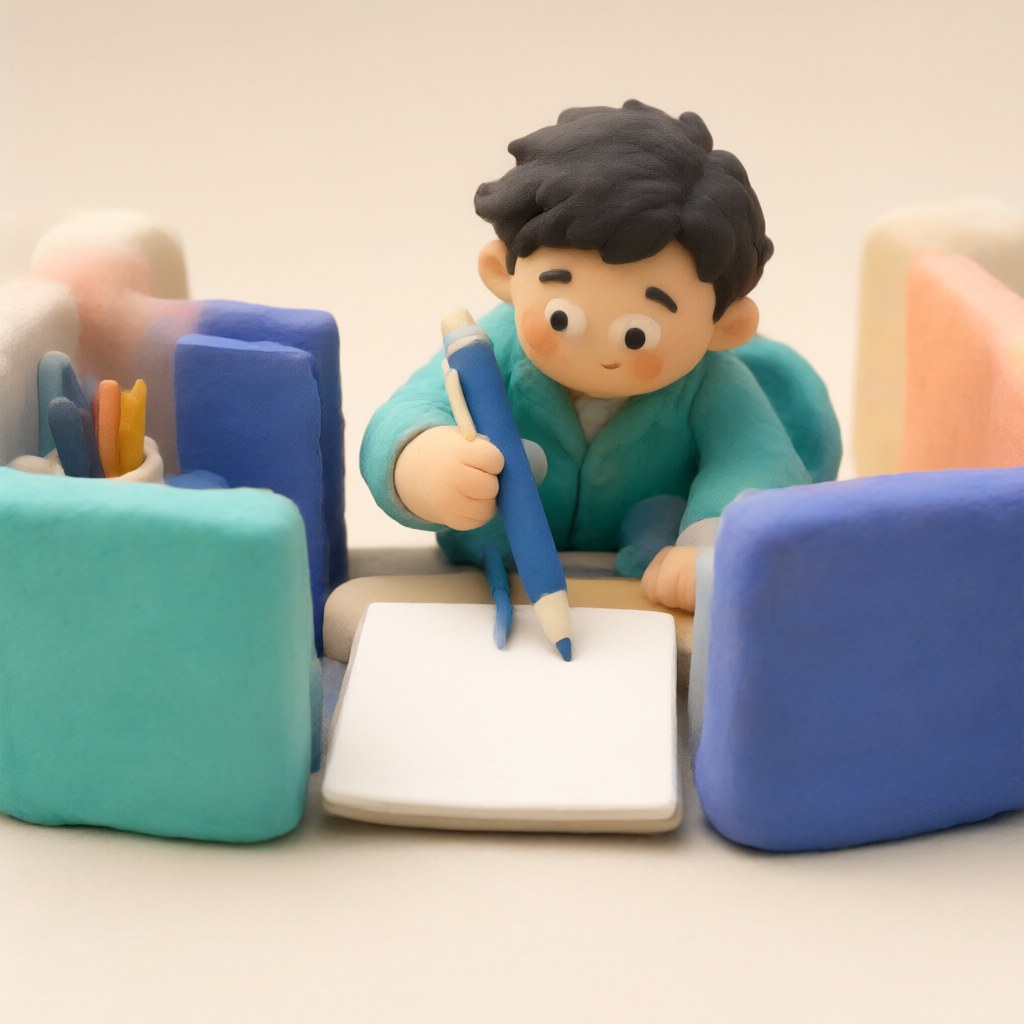
Julia Cameron named a specific version of the same exercise "morning pages" in The Artist's Way (1992): three handwritten pages, every morning, before anything else. The volume is deliberate. A large amount lets the first part of the writing be pure draining, so that what arrives on page three has not passed through a filter.
The two are not the same tool; the table makes the difference concrete:
| Feature | Freewriting (Elbow) | Morning pages (Cameron) |
|---|---|---|
| When | Any time of day, usually when stuck in a draft | First thing in the morning, before anything else |
| Stopping condition | Time-based: ten to fifteen minutes | Volume-based: three pages |
| Main purpose | Unblocking sentence-making | Draining the mind and muting the censor |
| Tool | Pen or keyboard, whichever is easier | Pen and paper |
| Expected result | Raw material for the current piece | An emptied head and a topic appearing |
| If you skip a day | Continue tomorrow, nothing breaks | The chain breaks; restart the same day |
The choice is simple. If you have a topic and cannot build sentences, freewrite. If you have no topic and a crowded head, use morning pages. If you have both, give the morning to the pages and ten minutes of freewriting to the moment before your writing session.
Getting from rubbish to raw material
The first time you read the output you will probably be embarrassed. That is normal and unrelated to the exercise: you are comparing an unfinished text against published texts, which is not a fair comparison. The measure of this practice is not the quality of the whole page; it is the number of usable sentences. Over a normal week, two to four lines out of seven sessions is enough to call it working.
Second point: the raw output should not go straight into the draft. A sentence written without the censor often carries the right direction in the wrong tone for a reader. Your job is to take the direction and rebuild the tone. That is why you leave a gap between writing and using — at least a day.
If your raw sentences keep circling one subject, that subject is probably what you actually want to write about and are avoiding. That repetition is one of the best outputs the exercise gives you, and it does not arrive by thinking.
Three extraction steps: marking, condensing, expanding
Without these three steps your notebook becomes a sealed warehouse. The whole job takes twenty minutes a week:
- Marking. Read once, quickly, and mark only places where something is new: a precise sentence, an image, a confession. Edit nothing and decide nothing on the first read. If you paused at a sentence, that pause is reason enough to mark it.
- Condensing. Rewrite each marked sentence on one line, in plain language, without decoration. Those lines are the list of your real topics, and they live in a separate file — not in the same notebook.
- Expanding. Pick one line and write a full paragraph: a claim, an example, a consequence. If the paragraph does not take shape in ten minutes, take the next line; good raw material does not resist.
The order matters. Most writers start at step three — jumping from notebook straight into draft — and then wonder why the draft reads like a diary in a formal voice. Marking and condensing are what create the necessary distance.
Realistic scheduling
Three handwritten pages take a different amount of time for every writer and there is no honest number to quote in advance; but one thing is certain: leave the session to "whenever there is time" and it will not happen. The practical move is to attach the practice to an existing habit: after putting the kettle on, before opening the laptop, after waking the child. A time and place anchor beats motivation; the full design is in the writing habit as a system.
If mornings genuinely do not work, move the practice rather than delete it. The evening version is weaker, because the critic has been awake all day, but it beats nothing. What actually kills the effect is writing occasionally, not writing in the evening.
Start the first week at the smallest workable amount: five minutes or one page, whichever is easier. The success condition for week one is not writing a lot; it is not writing zero.
Common mistakes
- Writing for publication. If you know someone will read it, sentences drift toward being defensible. Keep practice and publication in two files, ideally in two different apps.
- Quitting after a week. The usual reason is that you judged the output as a bad text. The real judgement belongs in the extraction step, not in the first read of the notebook.
- Replacing the real draft with the practice. Freewriting is a warm-up, not the race. If all your writing time goes into it, the actual piece never starts.
- Making it longer. A forty-minute session you never repeat does less than ten daily minutes. Fix the duration and let go of quality.
- Reading the output the same day. A one-day gap lets you read as a reader rather than as a tired writer.
Signs the practice is working
The result does not arrive as a sudden good idea, which is exactly why people abandon it early. The real signs are smaller: first sentences get written faster, the gap between sitting down and the first word shortens, and in the extraction session you find at least one line worth expanding. If after two weeks none of those three appear, the problem is usually volume rather than the exercise: cut three pages to one and continue for another two weeks.
If instead the output is abundant but all alike, it is time to add a constraint to the practice — forbidden words, a fixed number of sentences. That work is described in writing under constraints and complements this practice well.
Once the morning notebook yields usable sentences, the long-form drafting begins; Nevispar is built for that stage — drafting chapter by chapter with a clear structure, and editing that stays under your control.