How to Mind Map a Novel Before You Write: Map Your Story World

Honestly, most unfinished novels fail neither from a lack of ideas nor from weak prose; they fail because the author gets lost midway. That's the point where you've written eighty pages, you're carrying six characters in your head, and you're no longer sure which narrative thread to close first. The mental map of a novel was built precisely for this moment: to see the shape of the whole story on a single page before the words pile up.
How does a mental map differ from a plot outline?
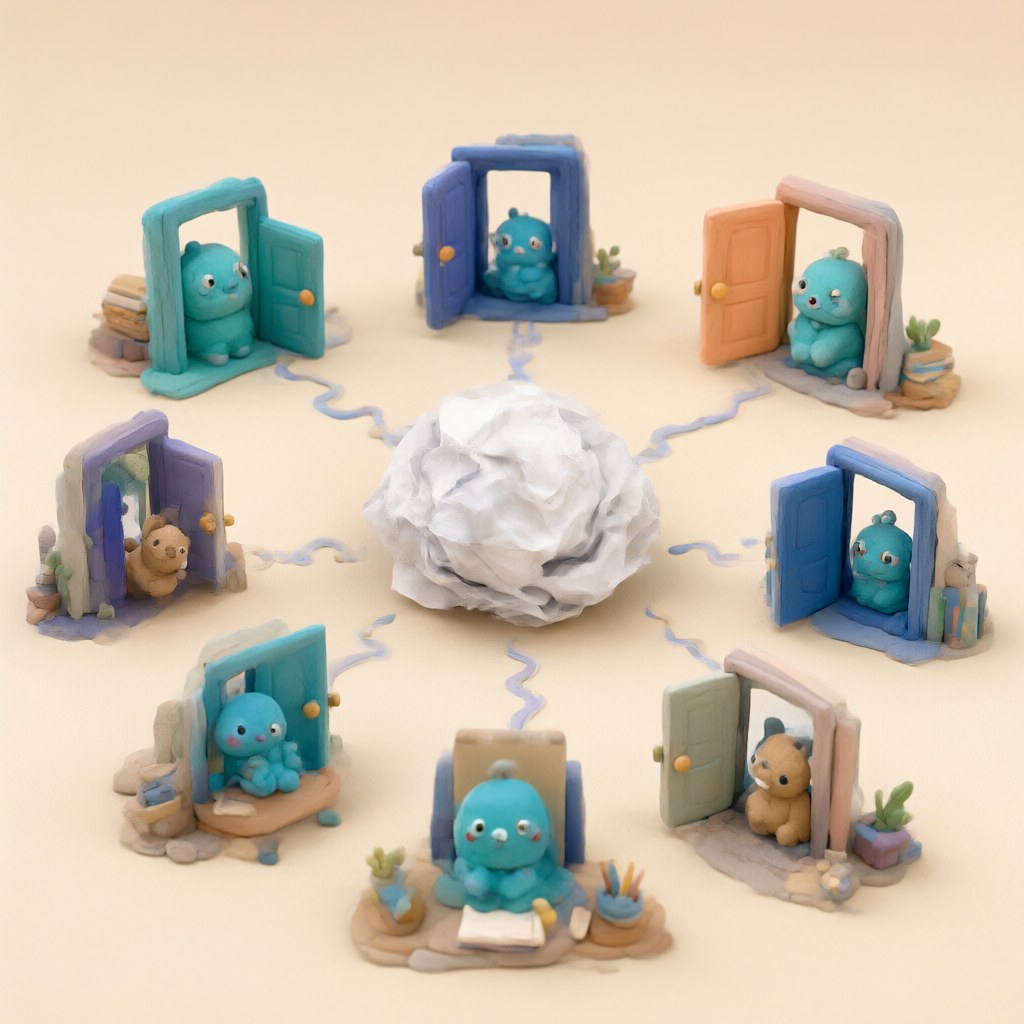
A traditional outline writes the narrative linearly: first this happens, then that. But a novel isn't linear; it's a network of desires, obstacles, and consequences. When you chapter it out in sequence before understanding that network, you're forced to make structural decisions in the dark. A mental map branches outward from a central core, and this radial structure better reflects the nature of story.
Tony Buzan, the British psychologist, popularized the mind map in its modern form in the 1970s; his argument was simple: the mind works with images, colors, and associations, not with tidy lists. Novelists have taken this idea and made it their own. J. K. Rowling filled a handwritten grid for Harry Potter and the Order of the Phoenix with columns for chapter number, main plotline, and story time; that very page has now been published as one of the well-known documents of her working style. Gillian Flynn, before writing Gone Girl, built a narrative calendar with precise dates so she would know who knows what and when.
The map's core: central tension, not a story summary
The most common mistake is to write a summary of the story at the center of the page. A summary is event, and event alone doesn't create pull. At the center of the map should sit the central tension; something that resembles a question more than a declarative sentence.
A concrete example: "A girl lives in a small town and discovers a family secret" is a summary; "What happens if, to preserve your family, you're forced to do the very thing that destroyed your father?" is a tension. The latter tells you which scenes are necessary and which are decorative.
"The king died and then the queen died" is a story. "The king died and then the queen died of grief" is a plot. — E. M. Forster, Aspects of the Novel
That short sentence shows that plot is not event; it's the causal relationship between events, and the mental map is the tool for seeing those relationships.
The five branches that almost no novel can do without
You can name the branches however you like, but these five axes almost always return. The table below can serve as a starting checklist:
| Branch | Guiding question | Practical output |
|---|---|---|
| Characters | What does each character want, and why can't they get it? | One sentence of want plus one sentence of obstacle for each main character |
| Story world | Which details of the environment change people's behavior? | Three to five environmental rules that affect the scenes |
| Main plot | From what state to what state does the central line move? | Opening state, point of no return, ending state |
| Subplots | From which angle does each subplot look at the main question? | A note linking each subplot to the theme |
| Theme | Which question does the story not answer, but deepen? | The core question in one line, without an answer |
From paper to software: tools and their uses
No tool writes a novel on its own; the right choice depends on your working habits:
- Wall paper and colored sticky notes: still the most powerful tool for seeing the whole structure at once. Its advantage is that moving a scene carries no psychological cost, and the mind thinks more freely.
- Mind-mapping software such as XMind and MindNode: well suited to radial branches and rapid expansion; especially in the brainstorming stage when you don't yet know the order of scenes.
- Scrivener’s Corkboard: A place between the map and the draft; each card is a scene, and you move the cards around to gauge the pacing of the narrative.
- Link-based tools such as Obsidian and Notion: When your note pages multiply and you want to create bidirectional links among character, place, and scene, they are more efficient than a static map.
Three Pitfalls That Make a Map Useless
- A Map More Crowded Than the Novel: If you have a hundred nodes on one page, you effectively see no pattern. Limit the main branches to five to seven and leave the details to a second layer.
- Locking the Map: A map is not a binding contract; it is a tool for vision. In the foreword to “The Lord of the Rings,” Tolkien writes that the story grew in the telling; a large part of the best scenes are the ones that were not on the map.
- Staying at the Level of Theme: “Loneliness” and “Betrayal” are themes, not scenes. Each branch must ultimately lead to a scene that can be described in one line: who, where, with what goal, and what goes wrong.
Bridging from Map to Draft
Until it becomes scenes, a map is a pastime. One practical way is to pull scene cards from each branch and organize them around the principle of “promise, progress, payoff”—the pattern Brandon Sanderson explains in his workshops: make a promise to the reader at the beginning, complicate it in the middle, and pay it off at the end. If you need help with structure, models such as Dan Harmon’s Story Circle or Blake Snyder’s Beat Sheet can serve as a bridge between map and draft.
In practice, the order of work is this: draw the map, identify the key scenes, and write the first scene that has the most pull—not necessarily the first scene. A first draft is meant to exist, not to be flawless. The map only ensures that on page two hundred you still know where you are going.
Conclusion
The mind map of a novel does not replace a detailed outline, nor is it meant to. What it does is this: before you drown in details, it lets you see the whole story at once, recognize lifeless tensions earlier, and know which character is merely decorative. One page, five branches, and half an hour are enough to give you a clearer picture of the novel you want to write.