Open vs. Closed Endings: Why Ambiguity Stays With Readers Longer

It is two in the morning; you have closed the book, and you cannot sleep. Not because of a difficult scene you have read, but because of a sentence the author wrote and ended with just when everything was about to be resolved. Tomorrow night you will still be thinking about it, and a month later, in an unrelated conversation, you will talk about that book. This persistence is not accidental; it is the result of a technical choice. Yet the debate between “open endings” and “closed endings” is not a debate about the absolute superiority of one form; it is about choosing the right tool for the work you are writing.
Closed Endings: The Comfort of Certainty and Its Hidden Cost
In a closed ending, accounts are settled: the murderer is revealed, lovers reunite or part forever, and the final paragraph tells the reader what happened and why. Classic detective novels, such as most of Agatha Christie’s works, are built on this contract; the reader has the right to receive answers on the last page, and if they do not, they feel cheated.
Where does the problem begin? Exactly where the reader’s mind no longer has anything to do. Narrative tension is discharged with every answer, and along with it, the motivation to return to the text collapses. A book in which everything has been explained becomes a fading memory after two weeks—not because it was weak, but because it left nothing “open” for memory to circle around.
Under the Skin of the Psyche: Why Ambiguity Does Not Let Go
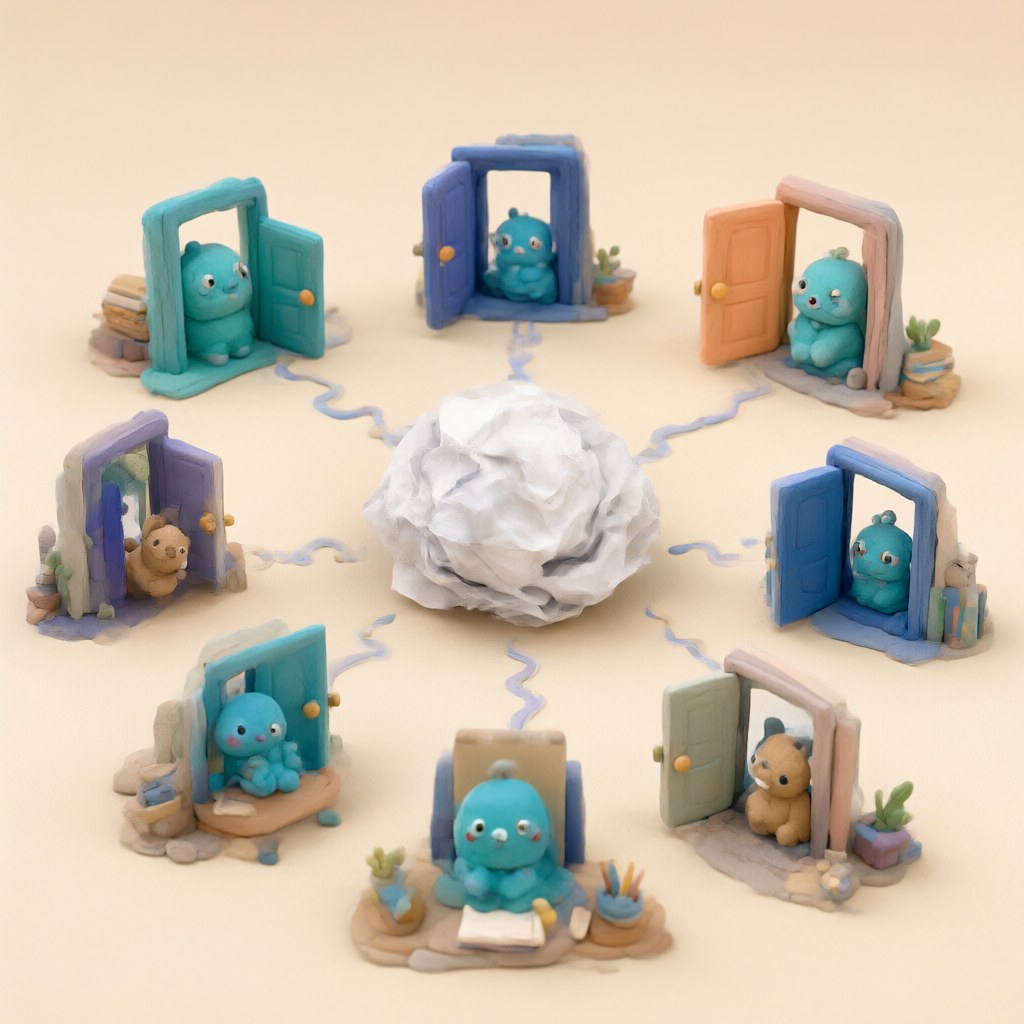
Psychology has a name for this phenomenon: the Zeigarnik effect. Unfinished tasks remain in active memory more than completed ones. The brain keeps open files with priority and visits them regularly. An ambiguous ending places exactly such a file on the reader’s desk.
The second factor is what researchers call the “need for cognitive closure”: an internal pressure to reach a definitive answer. Arie Kruglanski showed that this need varies in intensity among individuals, but it exists in everyone. An author who does not satisfy this pressure keeps the reader in a state of searching, and the reader involuntarily returns to the text, reassembles the clues, and completes the narrative for themselves.
The third consequence is a change in the reader’s role: from spectator to co-writer. When meaning is not completed in the text, it is completed in the reader’s mind, and this participation deepens the text’s emotional bond.
| Feature | Closed Ending | Open Ending |
|---|---|---|
| Fate of the protagonist | Clear and final | Probabilistic and multifaceted |
| Reader’s role | Witness | Co-writer |
| Common reaction | Calm and satisfaction | Restlessness, questioning, conversation |
| Persistence in memory | Shorter | Longer |
| Main risk | Rapid forgetting | Unsupported ambiguity and a sense of abandonment |
A Few Examples That Are Not Forgotten
Look at Chekhov. At the end of “The Lady with the Dog,” he explicitly avoids closing the story and keeps the future of the two characters in fog; but this fog is not the kind of gratuitous ambiguity—it is the result of the precise accumulation of earlier details. Hemingway in “A Farewell to Arms” leaves the protagonist in the rain without any explanation, and the emotional impact of the ending comes from this very silence. Kafka in “The Trial,” with its brief and shocking final sentence, makes shame and meaninglessness endure instead of an answer.
This technique also has a history in Persian literature. The twisty and doubtful ending of Sadegh Hedayat’s “The Blind Owl” suspends the reader between several readings, and for this reason it is still debated. Houshang Golshiri in “Prince Ehtejab,” through layered time and point of view, creates an ending that takes on a new shape with every reading.
“And it seemed clear to both of them that the end was still very far away, and that the most difficult and complicated part of the story had only just begun.” — Anton Chekhov, “The Lady with the Dog”
The Narrow Line Between Ambiguity and Abandoning the Work
Not every unstated ending is artistic. The difference lies in one thing: an open ending leaves a specific question open and has already put all the necessary clues in place for an answer; an abandoned ending leaves the reader alone with no clues at all. There is a simple test: consider two attentive readers; if they can construct two different and both valid readings of the ending, your ambiguity has worked. But if both reactions are the same—“What does that mean?”—the text has probably fallen short, rather than leaving things free.
Seven Practical Steps for Writing an Open Ending
- Choose one question. Only one or at most two questions should remain unanswered; leaving everything open turns ambiguity into confusion.
- Plant the clues earlier. Credible ambiguity is supported by rereading, not by surprise.
- Exit at the peak. Leave the scene before the conflict subsides; explaining after the climax drains the ending’s energy.
- Give an image, not a conclusion. A concrete object or physical movement stays in the mind longer than a paragraph of analysis.
- Keep the last sentence short. Long explanatory sentences, in the role of an ending, usually dilute the effect.
- Avoid moral summary. If you state the meaning yourself, the reader has nothing to discover.
- Apply the test of time. A week later, ask yourself what remains of the ending in your mind; if the answer is only “nothing,” the ambiguity was unsupported.
Conclusion
A closed ending is a contract that sends the reader out satisfied and at ease; an open ending is a seed planted in their mind that grows over time. Neither is absolutely better; but if your goal is the work’s lasting impact and sparking conversation about it, measured ambiguity is a more powerful tool. The condition for using it is that it be constructed carefully and with support, not out of weariness in the final act.